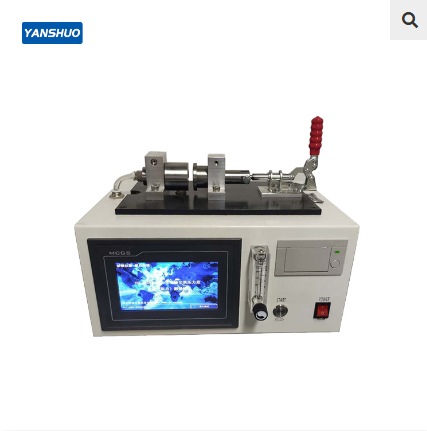
【Scope of application】
This test device is a special test instrument to test the reflection of fire of building materials or products (excluding floor paving materials) in the single combustion test to determine their ontological physical properties. This test device meets the requirements of the national standard for test conditions, and the specification is based on the test procedures (methods). After the test device test, the sample combustion performance (grade) can be determined, including quantitative (qualitative) test parameters: sample combustion heat release rate, whether flame lateral propagation occurs, calculation of the total smoke production of the sample (smoke production), and whether the sample burns whether dripping matter and particulate matter are generated. This test device has multiple testing functions to provide quality inspection departments and enterprises with high-cost-effective testing tools. This technical data cannot be relied upon as a basis for any request to the Company. The Company has the right to interpret this technical data. The company reserves the right to change the design on the basis of meeting customer requirements.
【Relevant Standards】
GB/T 20284-2006 “Single Combustion Test of Building Materials or Products”
【Scope of application】:
This test device is a special test instrument to test the reflection of fire of building materials or products (excluding floor paving materials) in the single combustion test to determine their ontological physical properties. This test device meets the requirements of the national standard for test conditions, and the specification is based on the test procedures (methods).
After the test device test, the sample combustion performance (grade) can be determined, including quantitative (qualitative) test parameters: sample combustion heat release rate, whether flame lateral propagation occurs, calculation of the total smoke production of the sample (smoke production), and whether the sample burns whether dripping matter and particulate matter are generated.
This test device has multiple test functions to provide quality inspection departments and enterprises with high-quality and cost-effective testing tools
· This technical data should not be relied upon as a basis for any request to the Company.
· The Company has the right to interpret this technical data.
· The company reserves the right to change the design on the basis of meeting customer requirements.
[Meet the standard]:
GB/T 20284-2006 “Single Combustion Test of Building Materials or Products”
【Technical Parameters】:
1. System temperature measurement range: 0~400°C; Measurement accuracy: ≤±0.5°C;
2. System differential pressure measurement range: 0~100Pa(MAX); Measurement accuracy: ≤±2Pa;
3. Smoke exhaust flow measurement range: 0.25m³/s~0.8 m³/s (MAX); Measurement accuracy: ≤±1.5%;
4. Gas flow control accuracy: < 647mg±10mg
5. Oxygen analysis (paramagnetic type) range: 16%~21%, response time < 12s,
6. Carbon dioxide (IR type) measurement concentration range: 0%~10%, linearity greater than 1% of the full scale,
8. Optical density measurement: measurement range 0%~99.9%; Measurement accuracy: not exceeding ±5% of the value of the filter light sheet;
9. Air relative humidity measurement: measurement range: 20%~80%, accuracy: ≤±5%;
10. Fuel: commercial propane gas, purity ≥ 95% (provided by the user);
11. Power supply: AC380V, 6KW;
12. Equipment floor size (combustion chamber and smoke exhaust pipe outline size): 6100mm×5500mm×4600mm (length×width× height);
13. Combustion room dimensions: 3000mm×3000mm× 2500mm (length× width× height);
14. Can be used through the local area network
15. It has an ignition failure alarm detection system
a. Main (secondary) burner ignition mode – fully automatic electronic igniter
b. Safety measure 1 – explosion-proof switch solenoid valve – safety measures
c. Safety Measures 2 – High Frequency Response Flame Detectors – Safety Measures
d. Safety Measures 3 – High Frequency Electronic Igniters – Safety Measures
e. Safety measures 4 – domestic well-known brand gas hose – safety measures
f. Safety measure 5 – explosion-proof electrical isolation box – safety measures
g. Combustion chamber footprint – 3000×3000×4300 (mm)
h. Control cabinet computer desk-1200×800×1200 (mm)
i. System requires laboratory area – 6000×5500×4600 (mm)
j. Total system power – 380V, 6Kw; The length of the equipment cable extends out to 2m
k. Cabinet – all-steel frame, steel plate spraying or stainless steel mask
l. This system is fully automatic controlled by computer, and this system does not include oxygen and propane cylinders for testing
[Test items]:
1. Combustion heat release rate of materials (products).
2. The total smoke production of materials (products).
3. Lateral propagation of material (product) flame (rate)
4. Materials (products) dripping and particulate matter
[Introduction to system composition and functional characteristics]:
Introduction to the composition of the device:
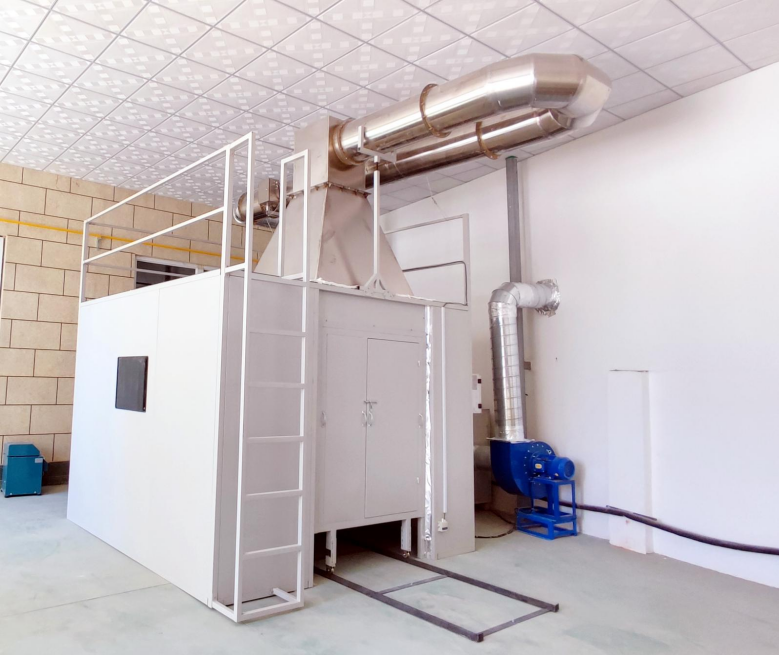
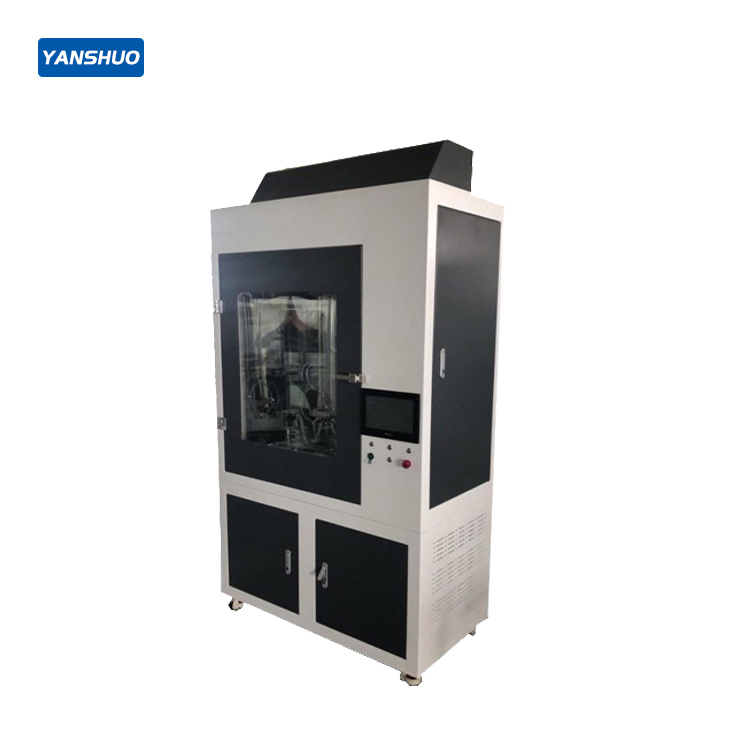
DT-1 building materials and products single combustion test device includes: control system, combustion chamber, specimen installation trolley, burner, flue and smoke exhaust system, analysis and measurement system, and dust removal device, as shown in the figure.
Test principle: the long and short wing test pieces (building materials) are fixed on the trolley in an L-shape, the trolley is pushed into the combustion chamber, the fan is started and the volume flow rate of the smoke exhaust pipe is adjusted to the specified range through the frequency converter, the auxiliary burner away from the specimen is ignited, the heat release of the burner itself is determined, the auxiliary burner is turned off, the main burner is ignited with the same mass flow rate of gas, and the heat release and smoke production of building materials are calculated and evaluated through the 20min test, and the lateral propagation of flame and the combustion of dripping and particulate matter are observed.
Introduction to the components and characteristics of the device:
1. Combustion chamber: The combustion chamber of the equipment produced by our company has two structures, and users can choose freely. One is a brick-concrete structure, and the other is a steel plate frame structure.Brick-concrete structure combustion chamberThe advantages are safety, strong and durable, good insulation effect, neat and beautiful appearance, but the disadvantages are troublesome to make and inconvenient to disassemble and assemble;Combustion chamber with steel plate frame structureThe advantage is that it is easy to disassemble and assemble, the disadvantage is that it is not strong and durable, and long-term combustion test will have heat deformation, tight sealing, wall steel plate will oxidize and discolor due to high temperature, short service life and other disadvantages.
2. Flue and smoke exhaust system: This part is composed of air collection hood, exhaust duct, measuring pipe, exhaust fan, etc., and the measuring pipe is a design structure with thermal insulation function in the middle of the double layer, which strictly meets the standard requirements and ensures the accuracy of data measurement and collection. The data measurement and collection section of the smoke exhaust pipeline is equipped with sensors that are useful for measuring temperature, light attenuation, O2 and CO2 concentration, and pressure difference, and the data collected by the equipment is calculated and evaluated, and the 5.5KW centrifugal draft fan is used, which can fully ensure the air speed and volume requirements required for the test.
3. Combustion system: The combustion gas is high-purity commercial propane gas, the mass flow controller accurately controls the amount of propane gas delivered, the solenoid valve is used to control the transportation of combustible gas, the high-frequency electronic igniter and ignition needle are automatically ignited, and the optional flame detector detects the ignition result. In addition to this, the equipment is designed with adequate safety measures. First of all, the entire combustible gas conveying and control components are separately arranged in an independent explosion-proof box and placed separately.
4. Analysis and measurement system
1) Oxygen and carbon dioxide analyzer: the analyzer is the key measurement element of the device, the accuracy can also meet the requirements of the standard, and the analyzer is directly embedded and placed on the control cabinet, the measurement data is directly displayed on the LCD screen, very intuitive, easy to operate, the back panel of the instrument is equipped with a special calibration entrance, which is very convenient for users to calibrate and calibrate later.
2) The measurement of pipeline pressure is measured by pressure transmitter, the temperature of pipeline gas is measured by thermocouple, and the temperature, humidity and atmospheric pressure index of the combustion chamber is measured by an integrated temperature, humidity and atmospheric pressure transmitter.
3) Smoke density analyzer: The analyzer is composed of a light-emitting unit and a light-receiving unit, and analyzes the size of the smoke density in the pipeline according to the degree of the emitted light wave is blocked by the flue gas in the pipeline. The analyzer is equipped with a self-calibration program that can be calibrated at any time to ensure measurement accuracy one step closer.
5. Control system: It is composed of a control table and a microcomputer system, and the whole device is automatically controlled by computer.
【Installation dimensions of the device】:
If the dust removal device is placed indoors, the indoor dimensions are 7500*7500mm*4500mm≥ If the dust removal device is placed outdoors, the indoor dimensions are 6000*4500mm*4500mm*4500mm≥
【Installation conditions:】:
1. Space requirements:
a. Overall dimensions: Combustion room Dimensions: 3000mm×3000mm×4500mm (length×width× height)
Weight (KG): 2 tons
b. Test bench: the equipment covers an area of 6100mm×5500mm× 4500mm (length×width× height)
The length of the laboratory is not less than 8*width 6*5 meters, and the door height is not less than 3 meters and the width is 2.5 meters
2. Power requirements:
a. Voltage: three-phase 380V+10%V50HZ
b. Power: 5kW
3. Water source: none
4. Air source:
Not less than 95% propane gas, with pressure reducing valve, is used for equipment combustion.
Then prepare one bottle of pure nitrogen 99.999% and carbon dioxide 9.5%, which is used to calibrate the controller.
5. Pollutant description: soot
6. Ventilation requirements:
Exhaust fan + dust removal
The smoke exhaust pipe of the equipment needs to be connected out or connected to the smoke treatment and purification system
7. Other test requirements: The equipment is large, and it is necessary to bring its own forklift to unload the goods